


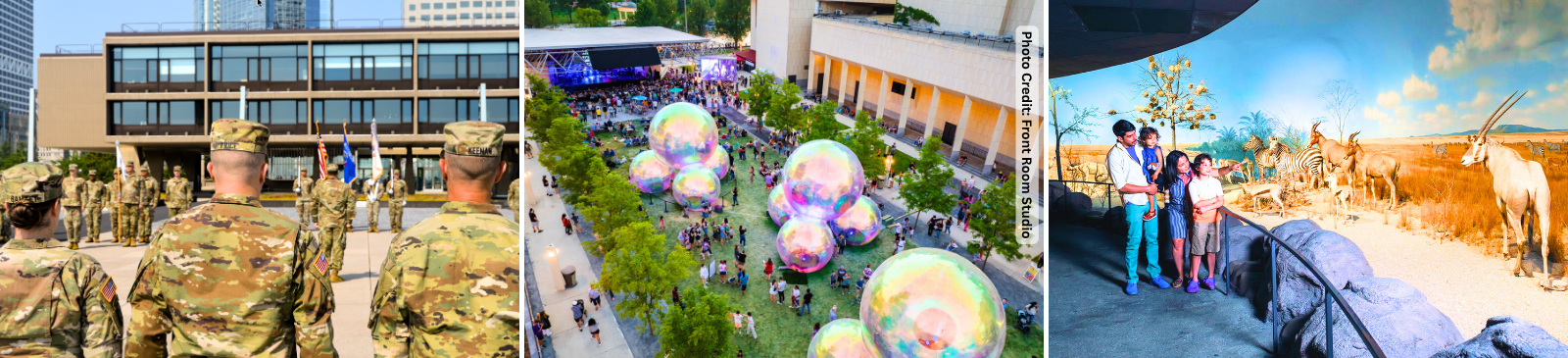
Milwaukee County Cultural Institutions
Driving Growth Through Arts & Culture
Cultural attractions such as museums, theaters, art galleries, and historical sites play a crucial role in driving economic growth within a community. By attracting tourists, creating jobs, improving residents' quality of life, and drawing businesses and talented professionals, these attractions significantly contribute to the local economy. Milwaukee County actively supports several key cultural institutions, including the Charles Allis Art Museum, Marcus Performing Arts Center, Milwaukee Art Museum, Milwaukee County Historical Society, Milwaukee Public Museum, Villa Terrace Decorative Arts Museum, and the War Memorial Center.
The Charles Allis Art Museum enriches Milwaukee’s quality of life by creating opportunities for residents and visitors to experience history, culture, and the arts, in particular by offering vibrant exhibitions and performances in a stately and intimate urban mansion, which permanently houses the art collection of Sarah and Charles Allis.
The Marcus Performing Arts Center (MPAC) was built in 1969 and deeded to Milwaukee County as a public trust for the preservation and enrichment of the performing arts, including drama, music and dance. A mission-based non-profit organization located in downtown Milwaukee, MPAC brings high-quality arts and cultural programming to Southeastern Wisconsin. Serving more than 200,000 people annually, MPAC brings a diverse range of celebrated performing arts to the region.

The Milwaukee Art Museum connects people with art, each other, and the world. 30,000 works of art. 400,000+ visitors a year. 125 years of collecting art. From its roots in Milwaukee’s first art gallery in 1888, the Museum has grown today to be an icon for Milwaukee and a resource for the entire state. The 341,000-square-foot Museum includes the War Memorial Center (1957) designed by Finnish-American architect Eero Saarinen, the Kahler Building (1975) by David Kahler, and the Quadracci Pavilion (2001) created by Spanish architect Santiago Calatrava. Central to the Museum’s mission is to share extraordinary works of art, reveal their compelling stories, and create meaningful experiences to grow and inspire our community.

MCHS was founded in 1935 as the repository for County records and since that time, has continued to expand its services to the community. More than one million documents and photographs and more than 60,000 artifacts are preserved by MCHS. Through education programs, exhibitions, the research library, our historic sites, and special events, MCHS offers Milwaukeeans and visitors to Milwaukee a chance to connect with the heritage of Milwaukee.

Pursuant to Wisconsin Statute 59.56(2), Milwaukee County (County) may acquire, own, operate, and maintain a public museum in the County, and appropriate funding for such purposes. As a museum of human and natural history, MPM provides a dynamic and stimulating environment for learning. The museum interprets the world’s cultural and natural heritage through collections, research, education, and exhibits. MPM holds its collections as a public trust and is dedicated to their preservation for the enrichment of present and future generations.
MPM Agreements & Supporting Documents

Villa Terrace and its Renaissance Garden are zoned as Milwaukee County parkland. Together, they serve the citizens of Milwaukee through the creation and promotion of local, regional and international visual and decorative arts, and a wide range of intergenerational community arts programming that includes theater, music, arts and crafts, creative writing, poetry, and gardening.

Dedicated on Veterans Day 1957 and designated a Milwaukee Landmark in 1974, The Milwaukee County War Memorial Center is the stunning architectural achievement of renowned Finnish-American architect Eero Saarinen, whose work also included the St. Louis Gateway Arch, New York’s John F. Kennedy Airport and Dulles International Airport in Washington, D.C. The War Memorial Center is a living memorial to “Honor the Dead by Serving the Living.” Its educational experiences bring to life this memorial and tell the stories of the veterans who served and sacrificed for our freedom. Over 50,000 veterans and 140,000 visitors rely on the Center each year. To maximize utilization of the facility, the Center is available for general use by the Public, veterans’ groups, art groups and civic groups.