


Milwaukee County Strategic Goals
Click each goal below to learn more about how we are measuring our progress:
Milwaukee County Goals
Create Intentional Inclusion
Bridge The Gap
Note: to see progress on Milwaukee County Department goals, visit the Milwaukee County Scorecard.
Create intentional inclusion in our workforce
Goals:
- Reflect the full diversity of Milwaukee County at every level of county government.
- Create and nurture an inclusive culture across Milwaukee County.
What does this mean?
When a workforce reflects the people it serves, everyone benefits. When a workplace has an inclusive culture, employees are more likely to be engaged and want to keep working there.
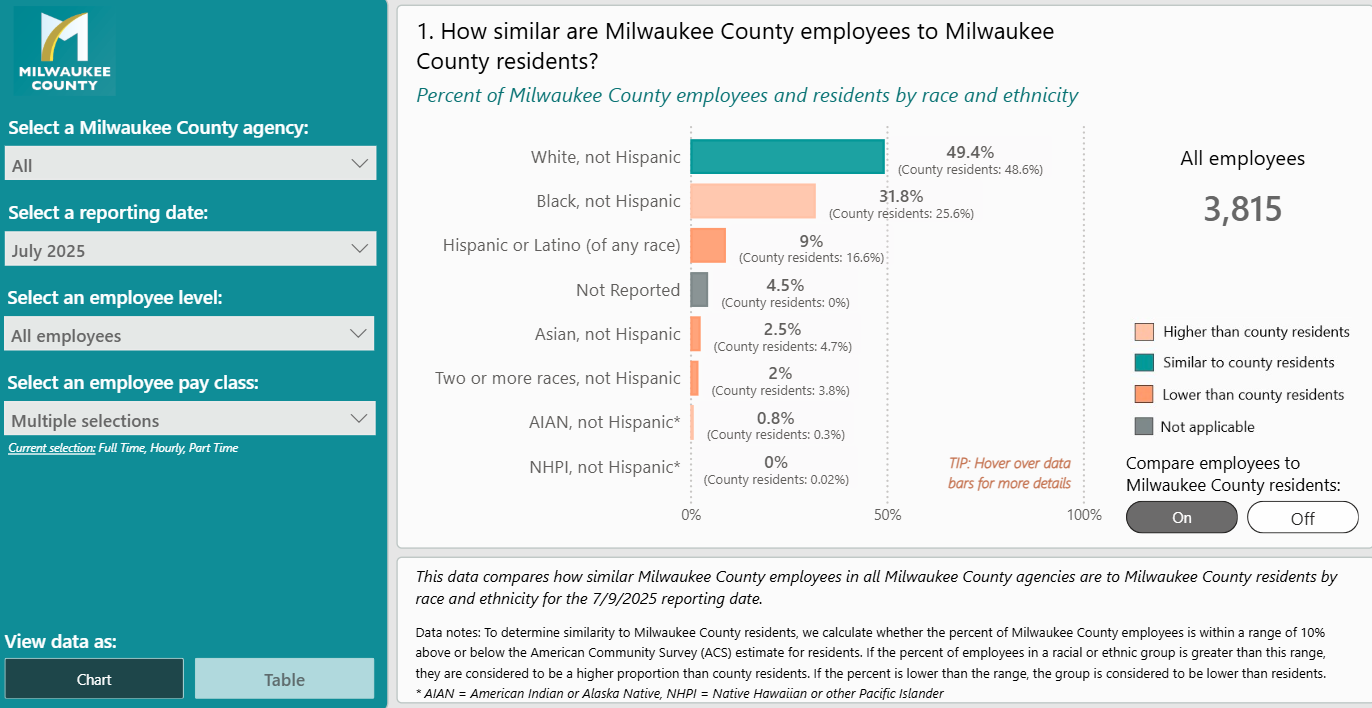
To see how well employees reflect the racial and ethnic diversity of Milwaukee County residents, visit our Workforce Dashboard.
How are we measuring success?
- Developed a Diversity, Equity and Inclusion Council with a mission to promote diversity, equity, and inclusion as fundamental values that enrich the workforce, services, and communities while building connectivity between Milwaukee County departments and divisions.
- Developed and supported Network Resource Groups, which aim to promote a positive and inclusive environment for all employees through education, networking, and workplace collaboration.
- Improved our data definitions and sources so we can track “People Managers” and all employees on our Workforce Dashboard.
- Improved 2024 Employee Engagement Survey scores for "employee experience" and "creating a culture of inclusion."
- Transitioned compensation to a Total Awards approach.
Create intentional inclusion in our contracting
Goal:
- Increase the number of Milwaukee County contracts awarded to minority and women-owned businesses.
What does this mean?
The more money Milwaukee County can spend with local contractors, the more we boost our local economy. Milwaukee County is working towards our contract spending to reflect the diversity of our Milwaukee County residents.
How are we measuring success?
- Leveraged Amazon for Business platform to drive County-wide diverse spend.
- Updated Milwaukee County’s Contracting Administrative Process and added a Contractor Code of Conduct.
- Launched a digital transformation project to improve contracting procedures from start (procurement) to finish (vendor payment) and enhance strategic use of Milwaukee County’s purchasing power to support economic prosperity.
- We are working on connecting our data systems so that we can holistically track certified business spending for Milwaukee County contracts. In the meantime, you can review recent reports on participation in business diversity programs.
Address health disparities
Goals:
- Determine what, where and how we deliver services based on the resolution of health disparities.
- Invest "upstream" to address root causes of health disparities.
What does this mean?
Learn more about why we believe racial equity is connected to the power to make change in our Health & Equity Framework.
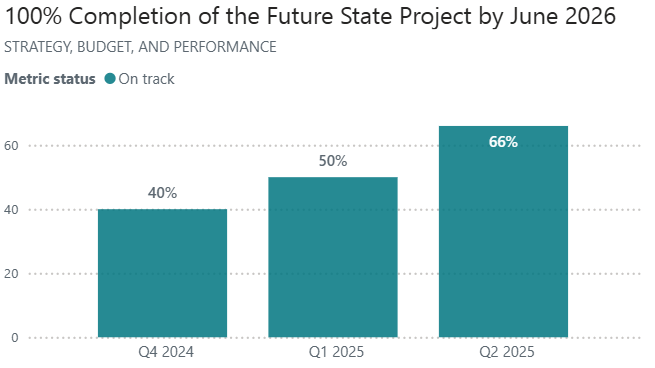
In order to know how we should deliver services and invest upstream, we are undertaking a Future State Project. This will help us assess our current state of what services we are delivering and how we do it, as well as create a recommended picture for what the "future state" of Milwaukee County government should be, if we want to achieve our goals.
How are we measuring success?
-
In 2024, Milwaukee County began its Future State Project to reimagine our entire service portfolio to meet the needs of Milwaukee County residents. This project includes creating a list of all Milwaukee County services, identifying gaps in our community and learning from other Counties about how they eliminate health disparities through their work.
-
So far, this project has reached out to 180 organizations to participate and engaged 1,368 people across 65 events and meetings.
-
The consultant team will share their final recommendations by December of 2026.
Enhance fiscal health
Goal:
- Enhance Milwaukee County's fiscal health and sustainability.
What does this mean?
Milwaukee County desires a balanced operating budget that sustains essential services for residents. In addition, we aim to have a reduction in our backlog of capital projects, ensuring essential assets are safe, functional, and meet community needs. We are trying new approaches to ensure Milwaukee County’s financial outlook - both for our operations as well as our capital needs - is healthy.
How are we measuring success?
- Revenue increases: Enacted a 0.4% Sales Tax in 2024 to bring new revenue to Milwaukee County; conducted a Revenue Inventory; increased Departmental earned revenue; secured capital funding for major projects including the Marcia P. Coggs Health and Human Services Center (open in 2025), Forensic Science Center (opening 2026) and others; and brought $130 million in new grant revenue since 2021.
- Healthcare savings innovation: Increased prescription drug rebates, recent opening of Employee Health Clinics.
- Long-standing pension liability reduction: Transitioned to the Wisconsin Retirement System and received dedicated funds for unfunded pension liability.

We want Milwaukee County's finances to improve over time but we currently see a downward trend. Reasons for the downward trend in 2026 include: it costs more to provide the same services, higher wages and overtime pay, more expensive employee benefits, and federal transit funding running out.
Note: Each dot shows the first year of that 5-year forecast period. For example, the 2026 budget deficit was from the 2026-2030 forecast.

Milwaukee County has many buildings and vehicles ("capital") projects that need repairs or replacement, and many of these projects are overdue or on hold. This graph shows what percentage of needed projects have actually been approved. When this percentage is low, it means we're only fixing a small portion of the buildings and vehicles that actually need attention.
Break down silos
Goal:
- Break down silos across Milwaukee County government to maximize access and quality of services offered.
What does this mean?
Breaking down silos means making sure that different areas of Milwaukee County government work together to serve the people. Milwaukee County is breaking down silos through three key initiatives:
- Creating Age-friendly communities within Milwaukee County that create a future in which Milwaukee County is embraced as “a community for a lifetime.”
- Building strong data governance that empowers effective decision-making across Milwaukee County with timely and credible data.
- Enhancing language accessibility and justice that ensures all of Milwaukee County residents can receive high-quality services in the languages they speak.
How are we measuring success?
Age-Friendly Communities
- Established a 21-member Steering Committee of community leaders and stakeholders.
- Accepted into AARP's Network of Age-Friendly Communities (2025).
- Selected Transportation, Housing and Health as action plan priorities, based on compilation of publicly available data, nearly 1,000 responses from community survey of residents age 45+, 5 walk audits in various Milwaukee County neighborhoods, and 5 focus groups with under-represented populations of older adults.
- The final draft of the Age-Friendly Milwaukee County action plan will be completed by the end of 2026 with implementation during the three-year period of 2027-2029.
- Learn more about Milwaukee County's Age-Friendly Communities Initiative
Data Governance
- Launched a cross-Departmental Data Governance Steering Committee (2024).
- Hired a new position in 2025 to lead Data Governance efforts at Milwaukee County.
- Completed the first committee-led data governance use case and are developing Milwaukee County's first data literacy training in 2026.
Language Access & Justice
- Included translation services as part of all Microsoft trainings for employees (2024).
- Launched English and Spanish closed captioning and translation services for County Board Meetings (2024).
- See the instructions for how to use closed captioning in Spanish or English here.
- Approved a new Language Access and Culturally and Linguistically Appropriate Services (CLAS) Policy.
- Office of Equity developed a Language Access training curriculum to support Milwaukee County departments and is engaging community partners to ensure language access practices are culturally responsive, accessible, and appropriate.
Equity through systemic change
Goals:
- Apply a racial equity lens to all decisions.
- Dismantle barriers to diverse and inclusive communities.
What does this mean?
Milwaukee County believes that your race should not determine your health or success in life. But today, that is often what happens. Racism was not an accident—it was built into many policies and decisions over time. Because of this, we must actively work to create fair outcomes and provide all leaders and staff with the tools they need to understand who benefits and who is harmed when making decisions.

Learn more at the Office of Equity's Racial Equity Accelerator.
How are we measuring success?
- Began prioritizing foreclosed home sales to owner-occupants.
- Launched the Building Bridges Program to offer technical assistance and $10,000 grants to small businesses seeking bricks & mortar locations through a new, dedicated Small Business Liaison position. Milwaukee County’s Building Bridges Program leveraged a $200,000 WEDC grant into $4 million+ in private investment, supporting 20 diverse businesses in 12 supervisory districts demonstrating an upstream model that multiplies impact and builds wealth throughout Milwaukee County.
- Developed vocational trainings for residents leaving the Community Reintegration Center.
- Developed Wisconsin’s first Bus Rapid Transit line and modernized passes and discounts (GoPass, UPass) for public bus transportation throughout Milwaukee County.
- Coming soon: Milwaukee County's Economic Empowerment Blueprint
Have Questions? Contact Us
Phone: 414-309-0292
Email: [email protected]